Oak industrial crossing timbers, and sleepers : A professional guide
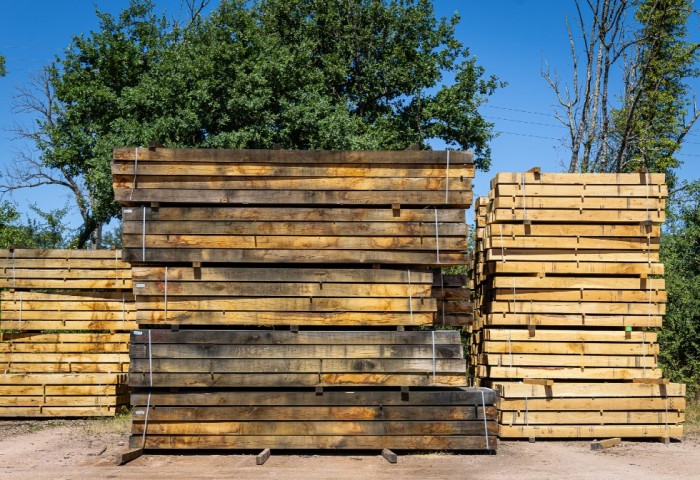
Oak sleepers, crossing timbers and bearers are historically associated with the railway sector, but this is now only one part of their market. Thanks to their strength and natural durability, these solid oak timbers now serve a wide range of applications in industry and landscape construction. Here is an overview of these products and what makes oak the reference species for this type of demanding structural work.
What are we talking about?
- Sleepers are heavy-section solid timber pieces, originally designed to support railway rails.
- Crossing timbers (switch timbers) are longer pieces, historically used as timber bearers for railway switches and crossings.
- Bearers (traversines) are smaller-section pieces, used to complement standard sleepers.
All three products are supplied ready to install, in standardised sections and lengths, making them straightforward solutions for any type of project.
Why oak for these applications?
The choice of oak responds to a demanding technical specification:
- High density and mechanical strength, needed to withstand heavy, repeated loads without deforming.
- Recognised natural durability (durability class 2 under EN 350), allowing the timber to resist biological agents even outdoors.
- Long-term performance under repeated loading and exposure to weather.
A growing use in landscape construction
Beyond their industrial origins, these same qualities of oak — density, strength, natural durability — are increasingly sought after in landscape and urban design.
Oak sleepers and crossing timbers are commonly used for:
- Edging and boundaries for paths, flower beds or car parks, laid horizontally or vertically.
- Retaining walls and earth retention, particularly on sloped sites, thanks to their ability to withstand significant lateral loads.
- Outdoor steps, planters and landscaped parking areas, where their rough-sawn finish gives a natural, rustic character.
- Exposed beams, partitions or industrial-style outdoor furniture, for more creative design projects.
Oak crossing timbers as a concrete alternative for platforms
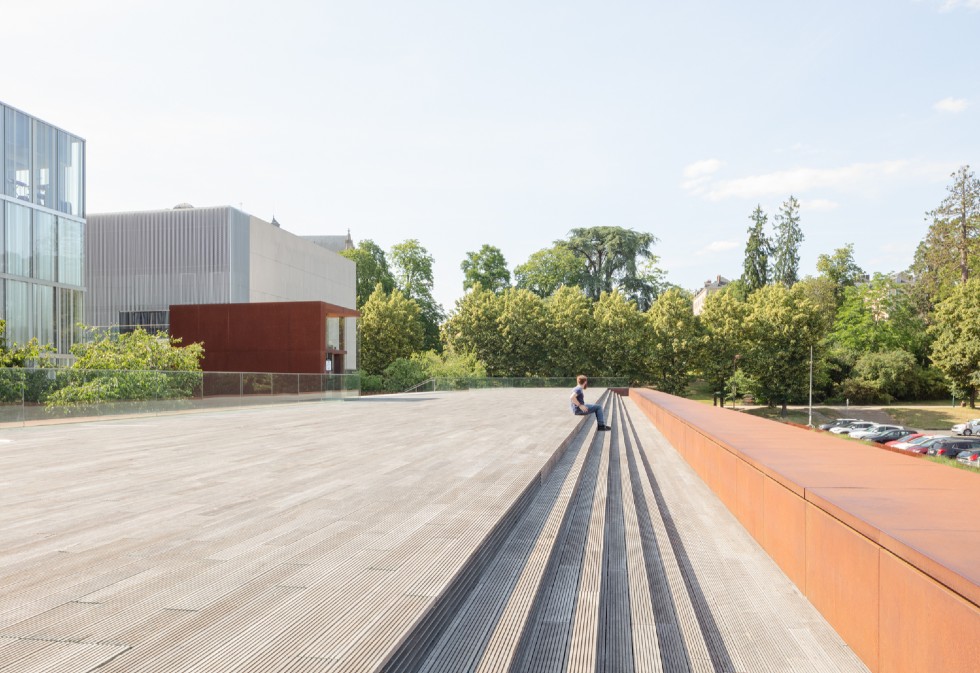
A more specific — and increasingly recommended — application by specifiers is the use of oak crossing timbers to build outdoor structural platforms, replacing a concrete slab. In practice, heavy-section timbers are laid side by side, on a stabilised base or on pads, to create a load-bearing surface suitable for pedestrian walkways, light-traffic parking, storage areas or technical platforms.
This solution offers several advantages over concrete:
- Faster installation, with no curing or pouring time required.
- A reversible, demountable solution, well suited to temporary or evolving developments.
- Good permeability, limiting run-off and helping with stormwater management — an increasingly valued criterion in urban and landscape design projects.
- A reduced environmental footprint compared with a concrete slab, in line with low-carbon strategies and the use of bio-based materials.
- Proven load-bearing capacity, inherited directly from the historical strength requirements of these solid oak timbers, a guarantee of solidity for architects and landscape designers who specify this solution.
This shift in application illustrates the versatility of heavy-section solid oak: a product originally designed for highly demanding constraints is now specified by architects and landscape designers for very different structures, while retaining the same requirement for robustness.
Reliable supply: a key concern for professionals
For merchants, industrial buyers, architects and landscape designers, the choice of supplier is critical: consistency of sections, long-term availability and traceability of the forest resource are all criteria that weigh on the purchasing decision. PEFC™-certified production guarantees sustainable management of the oak resource, a point increasingly scrutinised by both public and private clients.
In summary
Oak sleepers, crossing timbers and bearers remain, to this day, a proven technical response to the most demanding industrial applications. Density and natural durability make this a material that has stood the test of time, and one that is now finding a second life in landscape construction, becoming a credible alternative to concrete for certain outdoor platforms.
Do you have a landscape, platform or industrial oak timber project? Contact our team for a quote .