Oak timber framing: why choose squared timber for your construction projects?
The technical advantages of oak for timber framing
In the world of wood construction, not all species are equal. Oak stands out through a combination of mechanical and natural properties that make it a material of choice for load-bearing structures and exposed works.
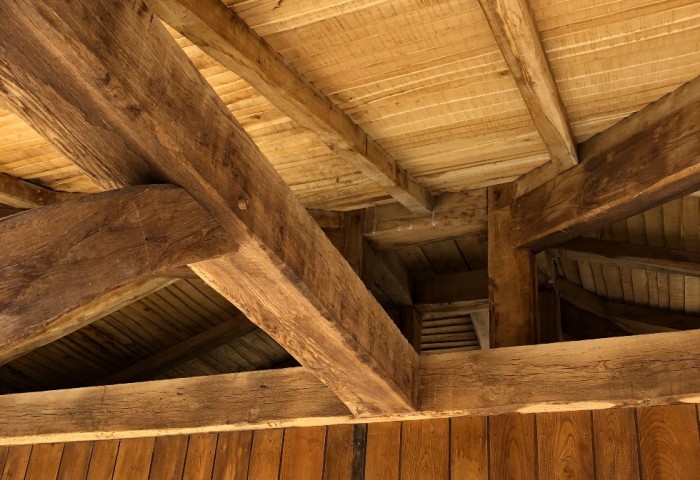
Its high density gives it superior compression and bending resistance compared to many softwoods. This structural robustness allows the design of long-span frames, lintels, ridge beams and tie beams without oversizing. Oak supports heavy loads while maintaining remarkable dimensional stability over time.
Furthermore, oak is naturally classified in durability class 2 to 3, meaning it durably resists biological attack (fungi, wood-boring insects) without systematic preservative treatment. For exposed frames or semi-exterior structures — conservatories, pergolas, agricultural building frames — this advantage is considerable in terms of maintenance and longevity.
Finally, its natural ageing gives it an authentic character, with tones that evolve towards a silvery grey outdoors or warm golden hues indoors — a major aesthetic asset for prestige projects or heritage buildings.
Oak squared timber: understanding the available grades
To meet the varying requirements of professionals, oak squared timber is available in several quality grades. Understanding these classifications is essential to optimise timber selection according to intended use, expected finish level and budget.
Grade QP1 — Sharp-edged: cut to order, sharp-edged sawn timber, sound tight knots and sapwood permitted. Recommended for exposed frames and quality finishing work.
Grade QP2 — Standard: wane tolerances permitted, sapwood present, sound tight knots with no size limitation. Ideal for concealed structures or shell construction works.
Both grades are available across a wide range of cross-sections, from 10×10 cm to 30×30 cm, covering virtually all common framing applications: beams, purlins, rafters, tie beams, common rafters, as well as lintels, conservatory frames and timber pergolas.
Responsible sourcing: PEFC-certified timber from French forests
Beyond technical performance, the choice of a structural timber supplier must today incorporate rigorous environmental criteria. The wood construction sector sits at the crossroads of climate challenges, and professionals bear direct responsibility within the forestry value chain.
PEFC certification (Programme for the Endorsement of Forest Certification) guarantees that timber comes from sustainably managed forests, following practices that preserve biodiversity, ecosystems and the rights of local communities. By requiring PEFC-certified timber from your suppliers, you actively contribute to the long-term health of forest cover and meet the growing expectations of project owners and sustainable building certifications (HQE, BREEAM, E+C- label).
The selected oaks come primarily from the forests of Burgundy, a region renowned for the exceptional quality of its oak stands. Sourced from high forests managed on long rotations, these timbers feature a tight grain and homogeneous fibre structure — a guarantee of optimal mechanical performance.
From sawmill to site: an integrated supply chain for consistent results
The quality of an oak frame is not limited to the choice of species. It also depends on mastery of the entire processing chain: from felling to delivery, including drying, sawing and grading.
An integrated industrial operator offers several decisive advantages for professionals. First, storage capacity: holding thousands of cubic metres in stock ensures supply continuity, even for large orders or tight deadlines. Second, drying expertise: insufficiently dried timber generates shrinkage, distortion and cracking that compromise installation and the durability of the structure.
Primary processing — flitches, squared timber, edged boards, decking — meets the needs of carpenters and builders who wish to work with raw timber. Secondary processing — glulam panels, door stiles, finger-jointed blanks — provides ready-to-use solutions for joiners and wood industry manufacturers.
Practical applications: where to use oak timber framing?
Oak squared timber finds its place in a wide variety of construction and fitting-out projects. Traditional roof structures for houses, barns or agricultural buildings represent the classic application, but oak adapts equally well to contemporary projects.
Bioclimatic conservatory structures make the most of oak's natural beauty for elegant, long-lasting living spaces. Pergolas and garden structures enhance outdoor areas while benefiting from the species' natural durability. Door and window lintels, subject to significant point loads, find in oak squared timber a reliable and noble material. Industrial or heritage frames showcase the strong image of French oak as a reference material.
Criteria for selecting a structural timber supplier
For a construction professional, the choice of an oak squared timber supplier should be based on several objective criteria: timber traceability and certification (PEFC), range of available cross-sections, supply consistency, drying quality and logistics responsiveness. An industrial partner with dedicated production facilities, significant drying capacity and a century of experience in oak processing offers the guarantees required for demanding projects.