Stair-Terrace at the ICADE Complex
Rungis (94)
A Graphic Design in Thermally Modified Ash at the Heart of an Urban Space
In contemporary urban developments, every material contributes to the user experience. It is no longer just about designing functional spaces, but about creating living environments where aesthetics, comfort, and durability coexist.
At the ICADE park in Rungis (94), which brings together business hubs and dining areas, wood stands out as a key element of the design. For these staircases, decking boards in thermally modified ash (THT) were selected to structure the space with modernity and coherence.
Wood in Urban Projects : A Strategic Choice
Why integrate wood into urban design ?
In highly mineral environments, wood introduces an essential dimension: warmth. It softens lines, creates contrast with materials such as concrete or metal, and enhances the overall perception of spaces.
Thermally Modified Ash : Performance and Aesthetics
What are the advantages of thermally modified ash for public spaces ?
Thermally modified ash offers performance perfectly suited to intensive outdoor use. This 100% natural process improves the wood’s durability, dimensional stability, and resistance to climatic conditions.
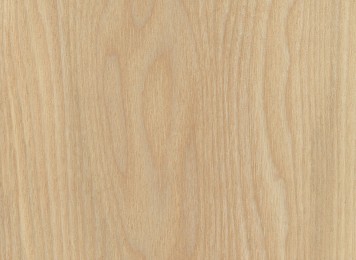
Another key advantage is the uniform transformation of the wood’s color throughout its thickness. Thermally modified ash features a consistent tone that will naturally evolve into an elegant patina over time, without compromising the project’s visual coherence.
This material therefore combines technical performance with visual quality—two essential criteria for public space design.
A Graphic and Functional Composition
How can stairs and wooden tiers structure a space ?
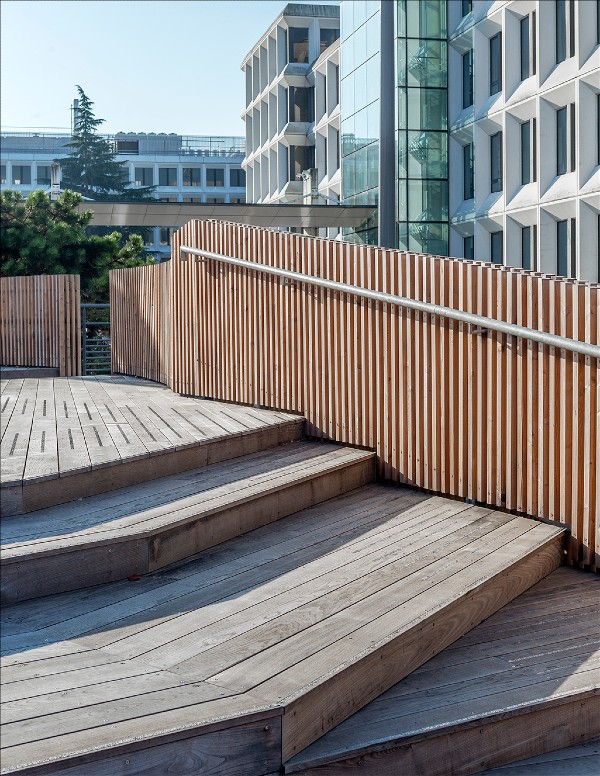
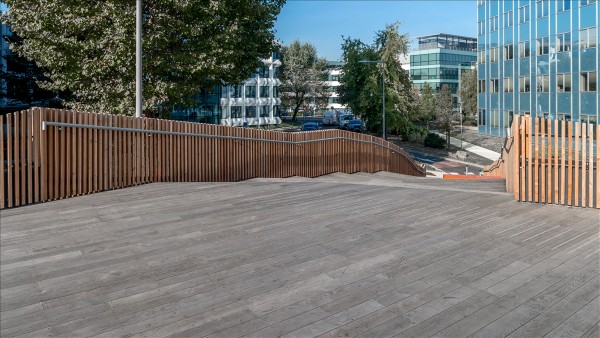
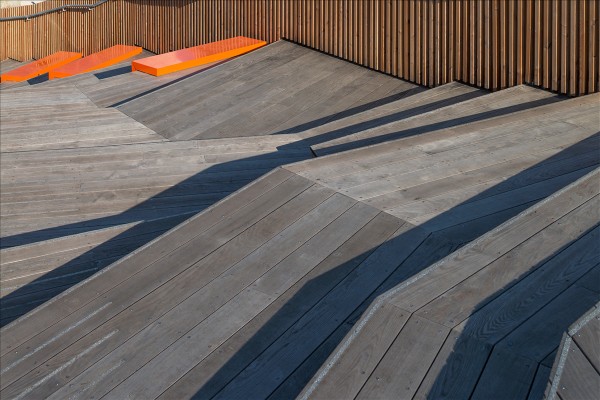
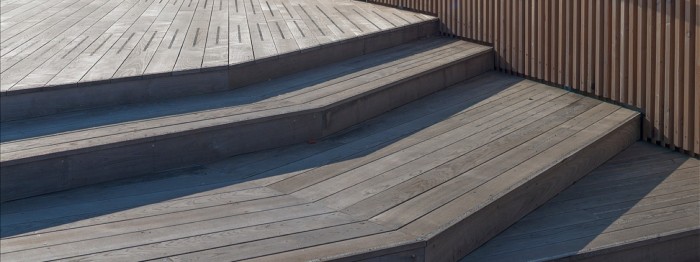
In this project, the staircases are not merely circulation elements. They become hybrid spaces, serving both as pathways and places to pause.
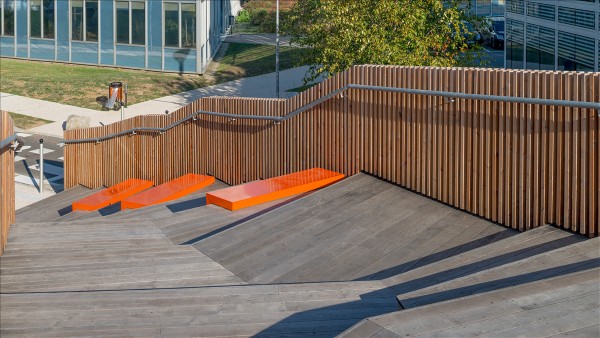
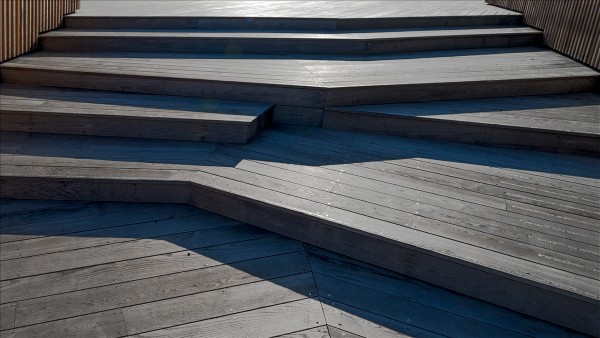
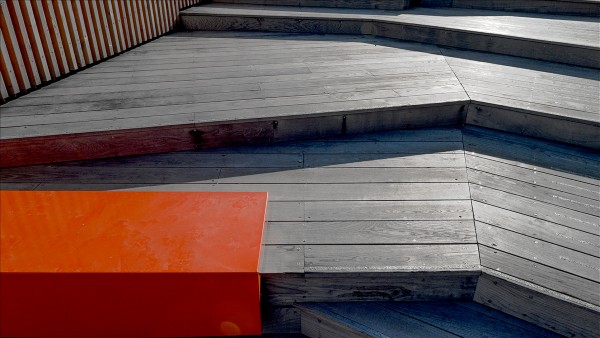
The design alternates between standard steps and enlarged landings, conceived as true terraces or seating tiers. This approach transforms a simple walkway into a living space where users can stop, sit, and enjoy the surroundings—particularly during lunch breaks.
The thermally modified ash boards enhance this graphic composition. They integrate harmoniously with the modern orange seating and natural wood railings, creating a subtle dialogue between materials and colors.
Safety and Durability at the Core of the Project
How can safety and longevity be ensured in a wooden public space ?
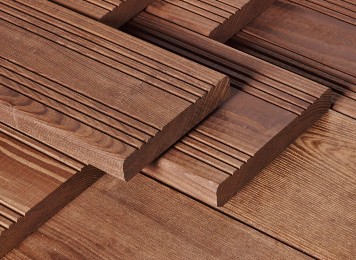
The decking boards used, from the Côtéparc® range, were designed to meet the specific constraints of public environments. Planed on two smooth faces, they also feature grooves for the application of anti-slip resin, ensuring user safety.
With a section of 21 mm thickness and 140 mm width, and a traditional fixing method, the structure guarantees strength and stability. The 250 m² surface area reflects the scale of the project and demonstrates wood’s capacity to meet large-scale urban design requirements.
A Living Space Designed for Users
Beyond its technical and aesthetic qualities, this project illustrates a shift in urban design : creating places where people do not just pass through, but choose to stay.
Wood introduces a human and welcoming dimension to public space, transforming staircases and terraces into true living areas.
Thermally modified ash thus becomes a structuring material, capable of meeting the demands of contemporary urban projects while offering a high-quality user experience.
Range : Côtéparc® – decking boards, planed on two smooth faces, grooved for anti-slip resin
Species : Thermally modified ash (THT)
Sections : 21 mm × 140 mm
Installation : Traditional fixing method
Surface area : 250 m²
Installer : Charpentes HOUOT, Sainte-Marguerite (88)
Photo credits : Ducerf Groupe